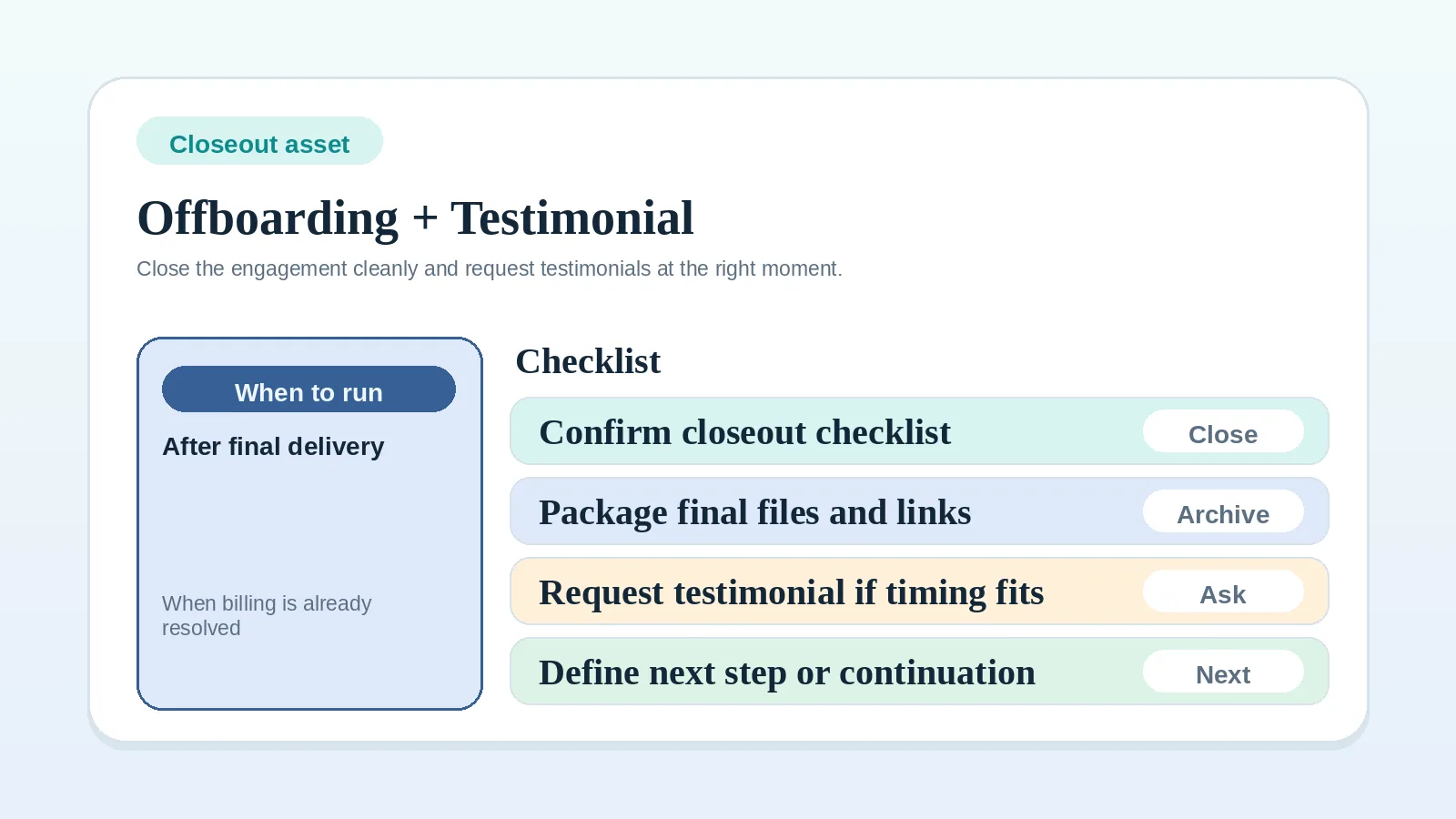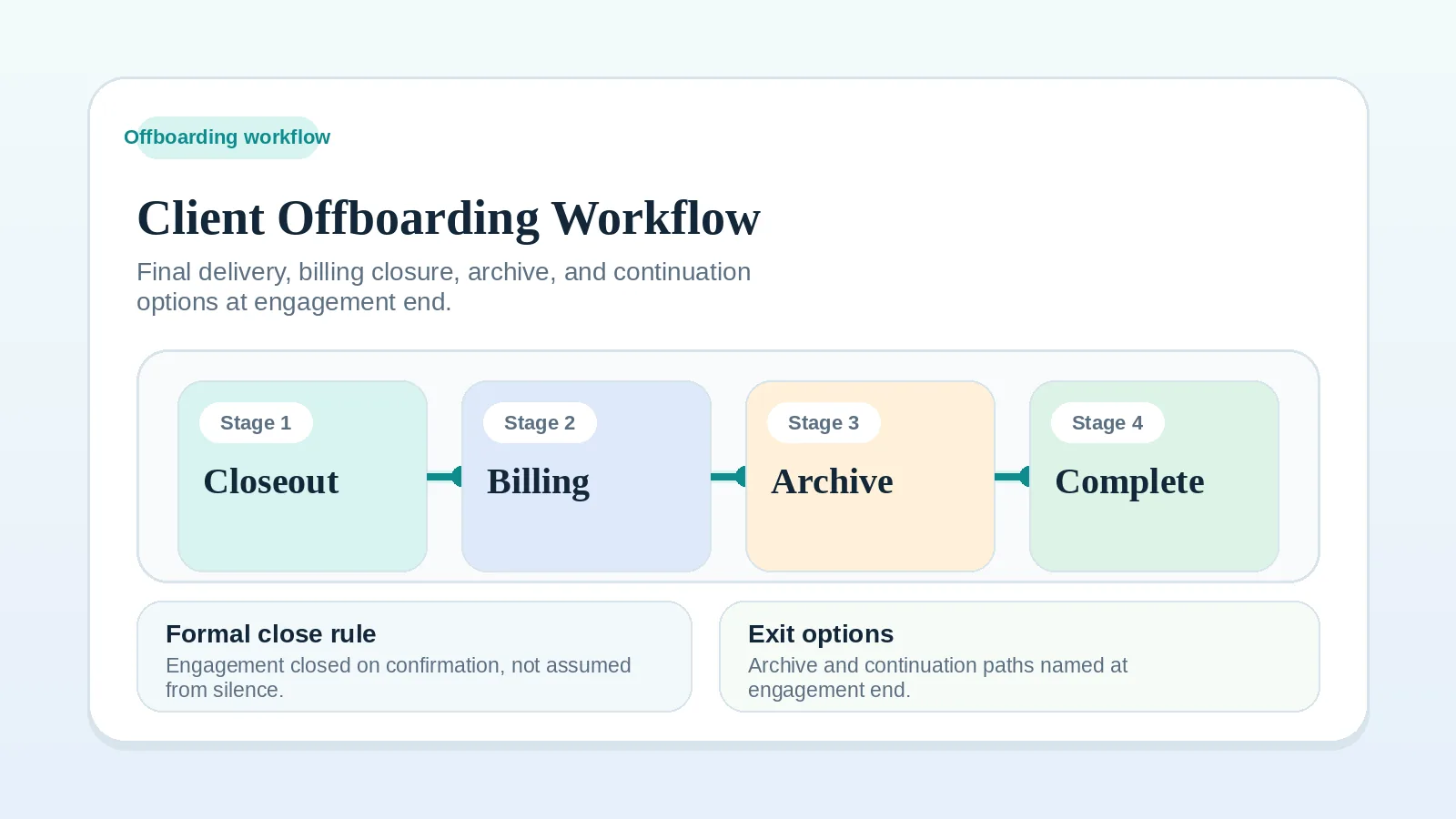
Offboarding confirms what was delivered, records the final decision and billing states, preserves the handoff record, and names what happens to the client relationship next.
It applies when the work is near completion and the open question is how to close the engagement. It defines the sequence between final delivery, signoff, billing status, record retention, and archive or continuation.
If the work is still under review or billing is unresolved, fix those stages first. Offboarding should start only when you can name what has been delivered, what the client still needs to confirm, and what payment state is expected next. Any testimonial request is optional and comes after those points are settled.
Follow the acceptance, payment, access, confidentiality, and retention terms agreed for the engagement. Use qualified advice when those obligations or the effect of closeout are unclear.
Who needs an offboarding process
- freelancers and consultants delivering scoped project work,
- solo service businesses that want explicit closeout and follow-on decisions,
- operators who keep “finishing” projects without ever closing them operationally.
If the project is still actively changing scope, use Change request workflow for freelancers and consultants before running this stage.
Closeout states to make explicit
Answer each of these before closing:
- what counts as final delivery,
- who gives final signoff,
- whether billing is actually closed,
- what documentation should be preserved,
- when a testimonial or referral ask is appropriate,
- what gets archived, handed over, or carried into a next engagement.
If any of those remains implicit, the project may feel emotionally complete while still being operationally open.
Loose ends that offboarding resolves
Value can still leak at the end of a project when:
- signoff is implied instead of explicit,
- closeout records are too weak to reuse later,
- testimonial timing feels awkward because the relationship state is unclear,
- continuation opportunities disappear because nobody names the next path.
Where offboarding sits in the lifecycle
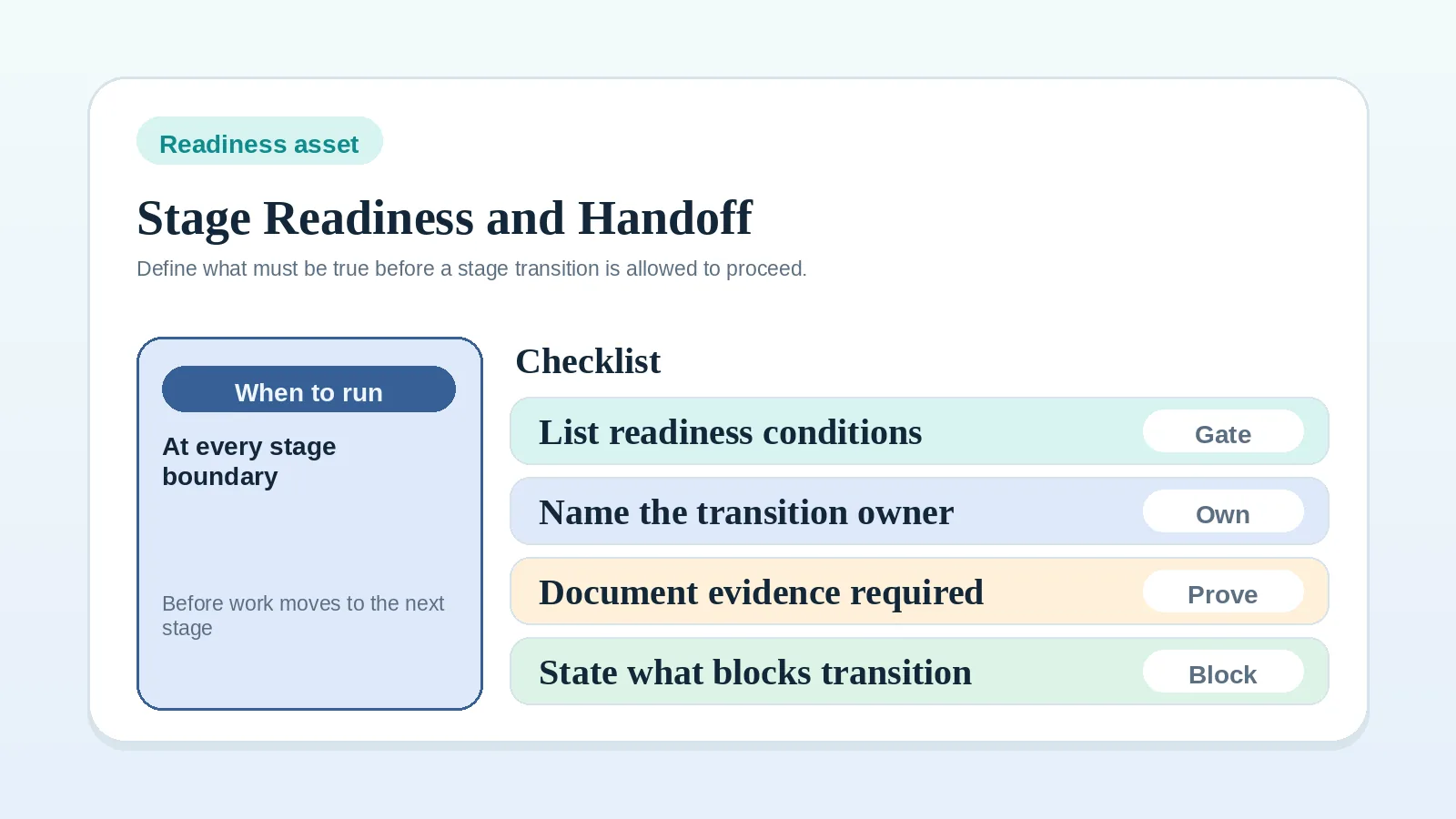
Offboarding starts after final delivery is ready to close and after the last major revision or change-request decision is already settled.
That means:
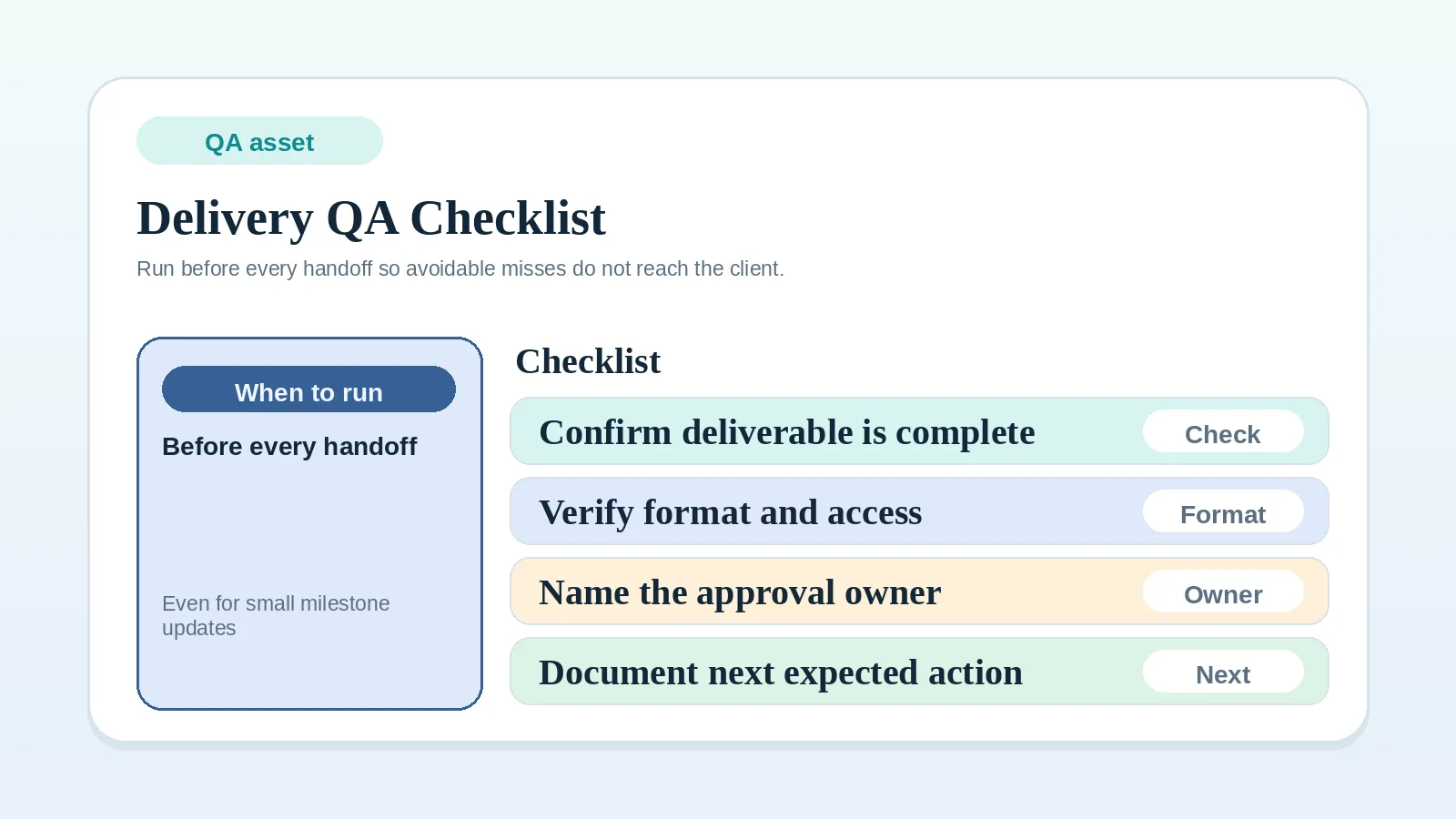
- delivery output is complete enough to hand over,
- the client knows what is being accepted or closed,
- the final invoice trigger is clear,
- no unresolved scope dispute is hiding inside ordinary follow-up.
For earlier stages, use:
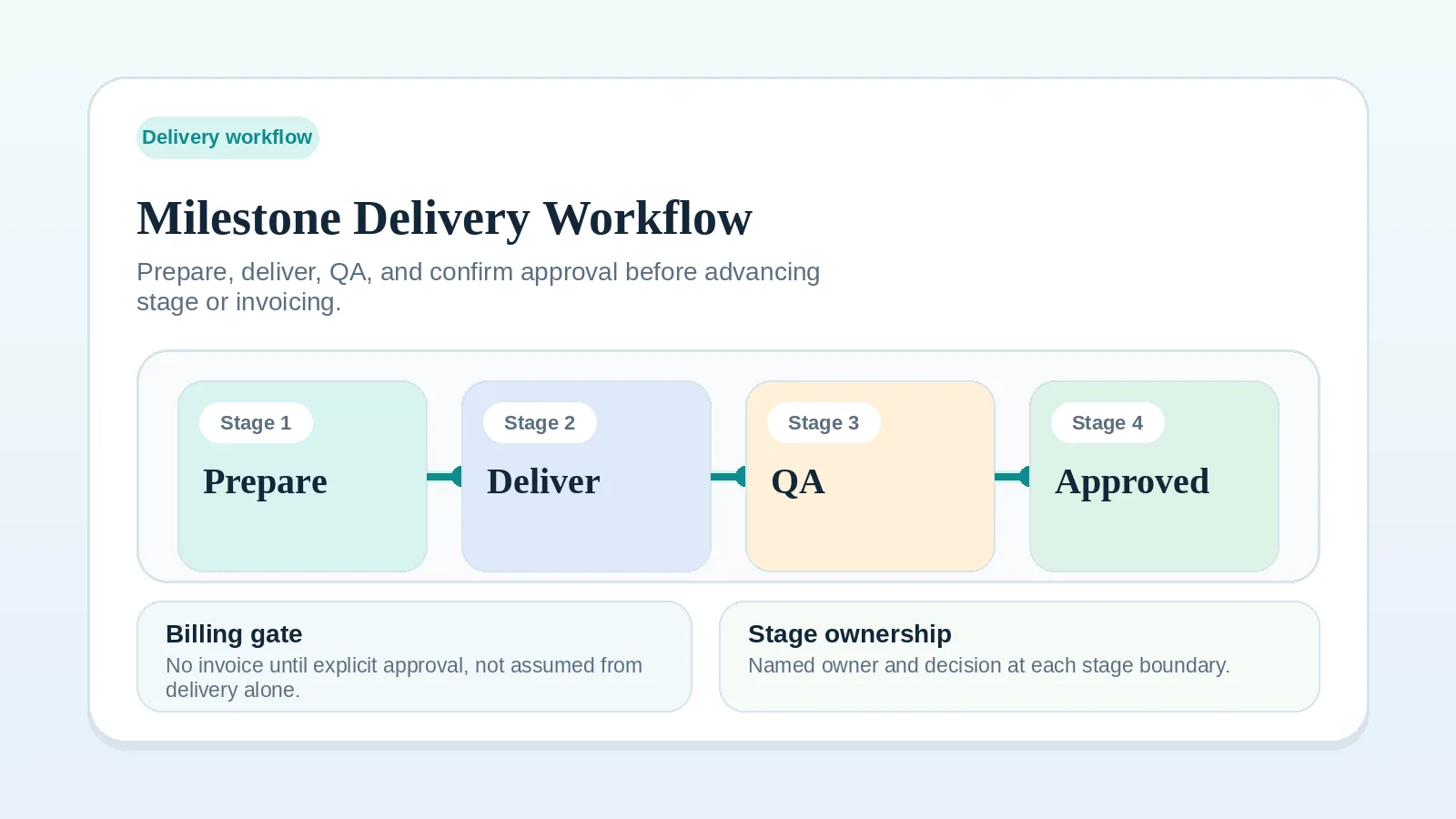
- Milestone delivery workflow for solo service businesses for final delivery control,
- Project handoff workflow for freelancers and solo service businesses for transferring final files, access, documentation, approval status, and next-step ownership,
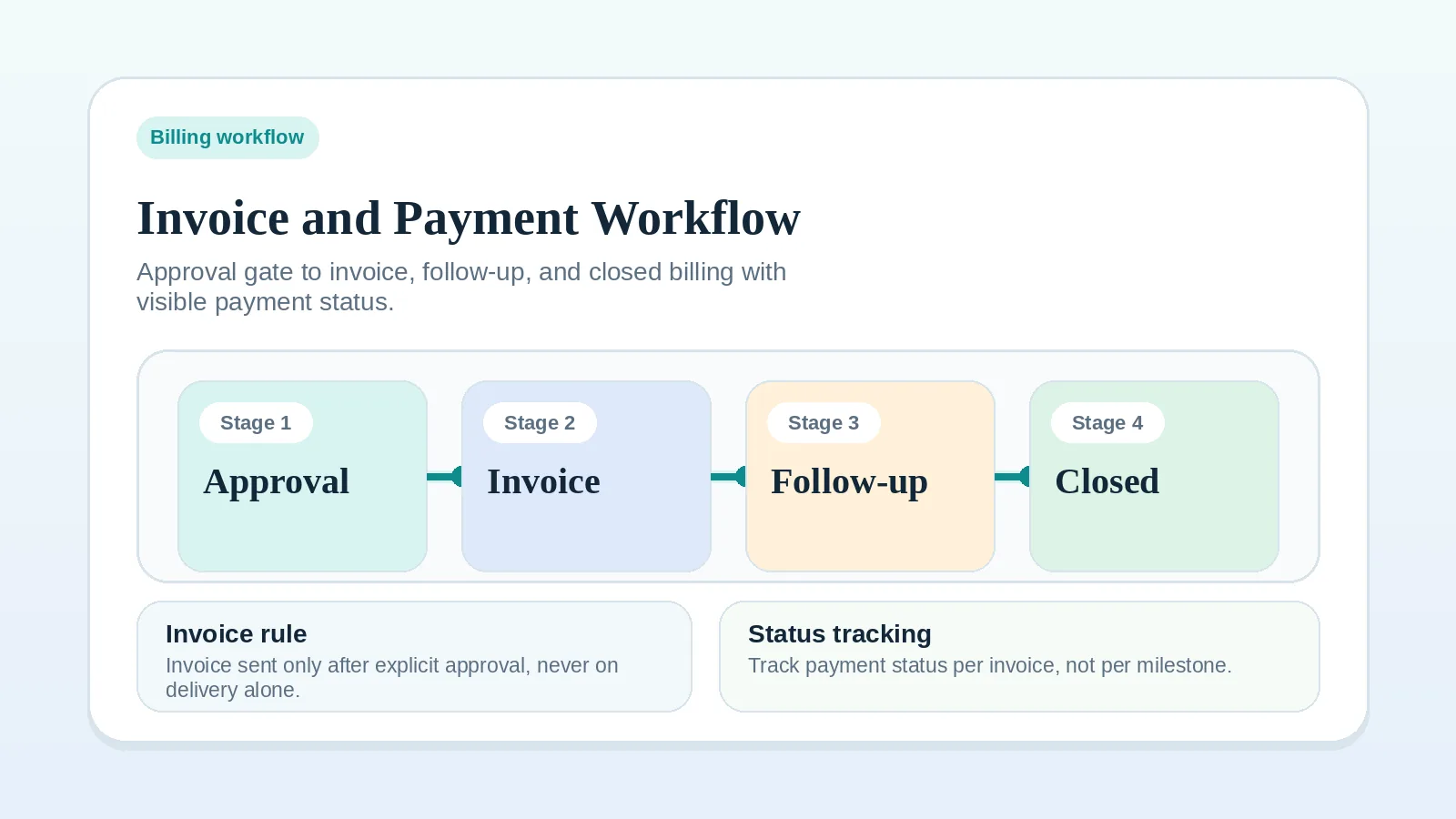
- Invoice and payment workflow setup for billing control,
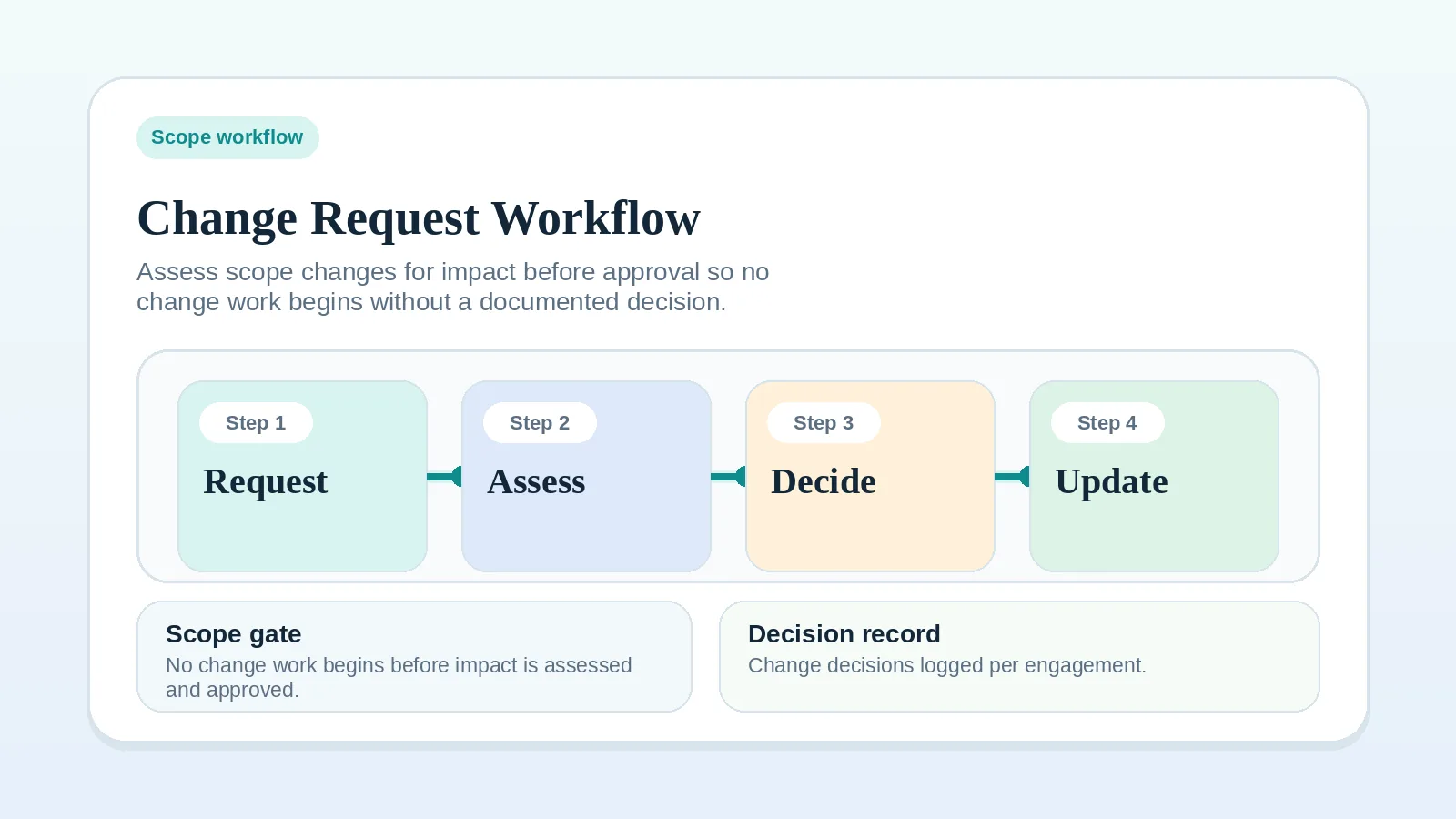
- Change request workflow for freelancers and consultants if the client is still trying to reshape the project.
Step 1: confirm closeout eligibility before you start
Before entering offboarding, confirm:
- the contracted deliverables are complete or explicitly closed,
- the client has what they need to review or use the work,
- any final revision boundary is already documented,
- the next action owner for signoff or payment is named.
If you cannot answer those points quickly, the engagement is not ready for offboarding yet.
Step 2: capture final signoff intentionally
Do not rely on vague completion signals such as:
- “looks good for now,”
- silence after delivery,
- internal feeling that the work is done.
Instead, define what counts as closeout:
- explicit acceptance,
- final revision complete,
- agreed close date,
- or project pause converted into a documented next-step state.
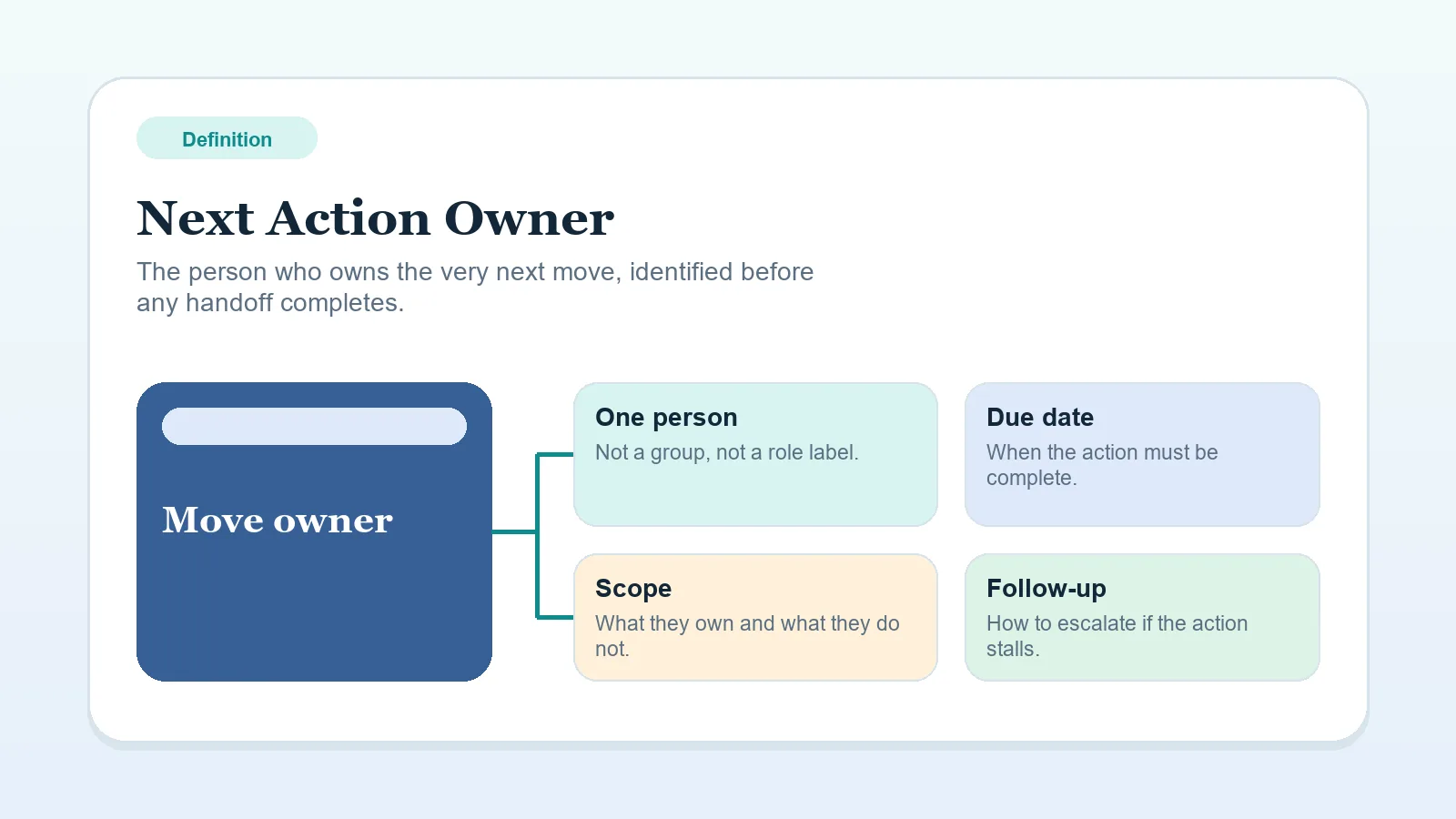
If the client response is needed, name the approval question directly and identify one Next action owner. If that owner is still unclear, the project can stall before closure.
If a response is positive but does not meet the agreed acceptance standard, use FAQ: what counts as client approval before billing or the next stage starts? before moving into billing closure or archiving.
Step 3: close billing and scope cleanly
Offboarding should not pretend billing is complete if it is not.
Before you move into testimonial or referral language, confirm:
- final invoice is triggered or already sent,
- payment status is visible,
- any open scope-change item is resolved,
- no hidden “small extra” request is still sitting in chat.
Closeout language should match the billing reality. If payment remains open, record operational closeout and financial closeout as separate states rather than implying that both are complete.
If final approval, invoice status, or closeout readiness is still uncertain, use the Approval and billing readiness checklist for solo operators before treating the engagement as ready for testimonial, referral, or archive steps.
Step 4: package the closeout record
Create one clean closeout record that captures:
- what was delivered,
- what outcome or result the client received,
- links to final files or handoff materials,
- unresolved recommendations or future opportunities,
- internal notes worth preserving for repeatability.
This record should be light enough to maintain and clear enough that your future self can answer: what did we finish, what is still open, and what should happen next?
Step 5: choose testimonial timing from the client state
Ask for a testimonial after the client has reviewed the outcome and any active delivery or billing issue is resolved.
Ask now when:
- delivery is genuinely complete,
- billing is orderly,
- the client has acknowledged value,
- there is no active frustration or unresolved issue.
Delay the ask when:
- final review is still pending,
- billing is tense,
- the client has not used or reviewed the final work yet,
- the relationship needs one more stabilizing touch before any request.
If those conditions are not present, record the request as deferred instead of attaching it to the closeout message.
Step 6: decide whether this is archive, handoff, or continuation
Record which kind of ending this is:
- Archive closeout: the work is done and should be stored cleanly.
- Client handoff: the client is taking over use, maintenance, or implementation.
- Continuation path: the current work ends, but there is a defined next engagement or retained support model.
That decision changes what you document, what you ask for, and what should remain active in the system of record.
Minimum offboarding checklist
Before marking the engagement closed, confirm:
- final deliverables are documented,
- signoff state is explicit,
- billing state is explicit,
- the next action owner is named if anything remains open,
- final files and links are stored where they can be found later,
- testimonial or feedback ask is sent or intentionally delayed,
- one internal lesson is captured.
If the boundary between an invoice closing and offboarding starting is still undefined, write it down with the Project start handoff readiness worksheet.
Practical closeout sequence
| Phase | Main question | Output |
|---|---|---|
| Closeout check | Is the project actually ready to end? | Confirmed offboarding start |
| Signoff | What counts as final acceptance? | Clear decision state |
| Billing closure | Is revenue state closed or still open? | Final invoice/payment visibility |
| Documentation | What should future you be able to find quickly? | Closeout record |
| Testimonial timing | Is this the right moment to ask? | Sent or deferred request |
| Archive or continuation | What happens after this engagement ends? | Archived project or next-step path |
Where closeout remains incomplete
- the project is treated as closed because delivery feels finished, but signoff never became explicit,
- final invoice is still unresolved while testimonial language starts too early,
- final assets are sent but not documented,
- a likely follow-on opportunity is left vague instead of intentionally deferred or proposed,
- the project is archived before the useful lesson is captured.
Closeout evidence worth preserving
Your closeout record should make it easy to answer later:
- what was actually finished,
- what the client accepted,
- what remained open or deferred,
- what made the engagement work or stall,
- what next opportunity, if any, was identified.
Closeout states that need separate records
- If the client goes quiet after final delivery, do not infer acceptance from silence. Use a bounded follow-up and name the decision you still need.
- If the project ends in a pause rather than a full close, store the status as paused with a next action instead of archived.
- If billing is delayed by procurement, separate operational closeout from financial closeout but keep both visible.
- If the work led naturally into a next phase, treat closeout and expansion as adjacent steps, not the same message.
Related pages
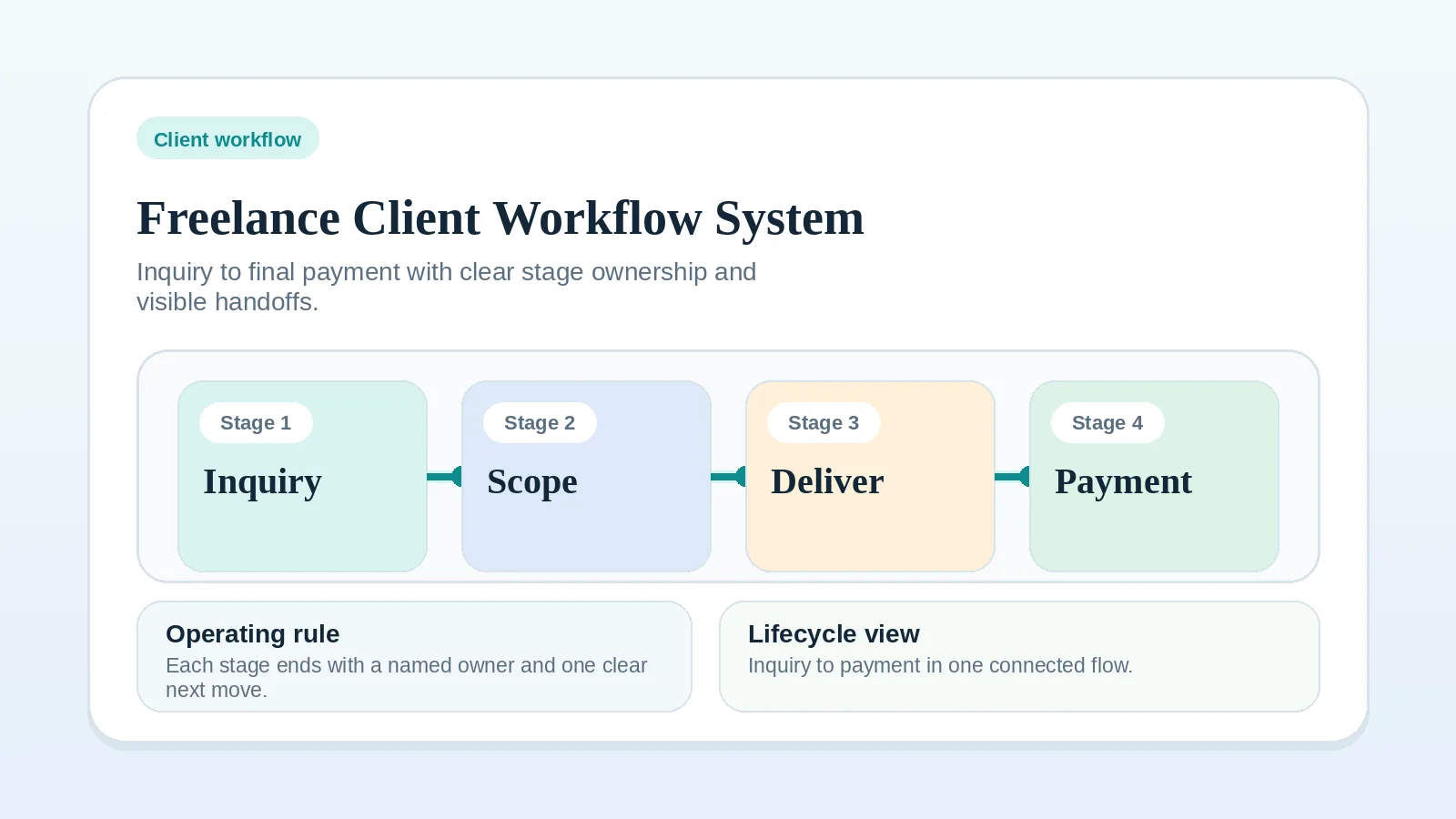
Record the closeout with the Client offboarding and testimonial request template. For the whole client path, see Freelance client workflow system: inquiry to final payment.
Offboarding completion check
The closeout record is ready when:
- closeout timing is no longer vague,
- signoff and payment states are both explicit,
- the final project record can be found without digging,
- testimonial or feedback timing is a recorded decision,
- the engagement ends with either a clean archive or a clear next-step path.
If final approval and billing are settled but the client does not acknowledge the formal project end, continue to Client not responding at project closeout: what to do.