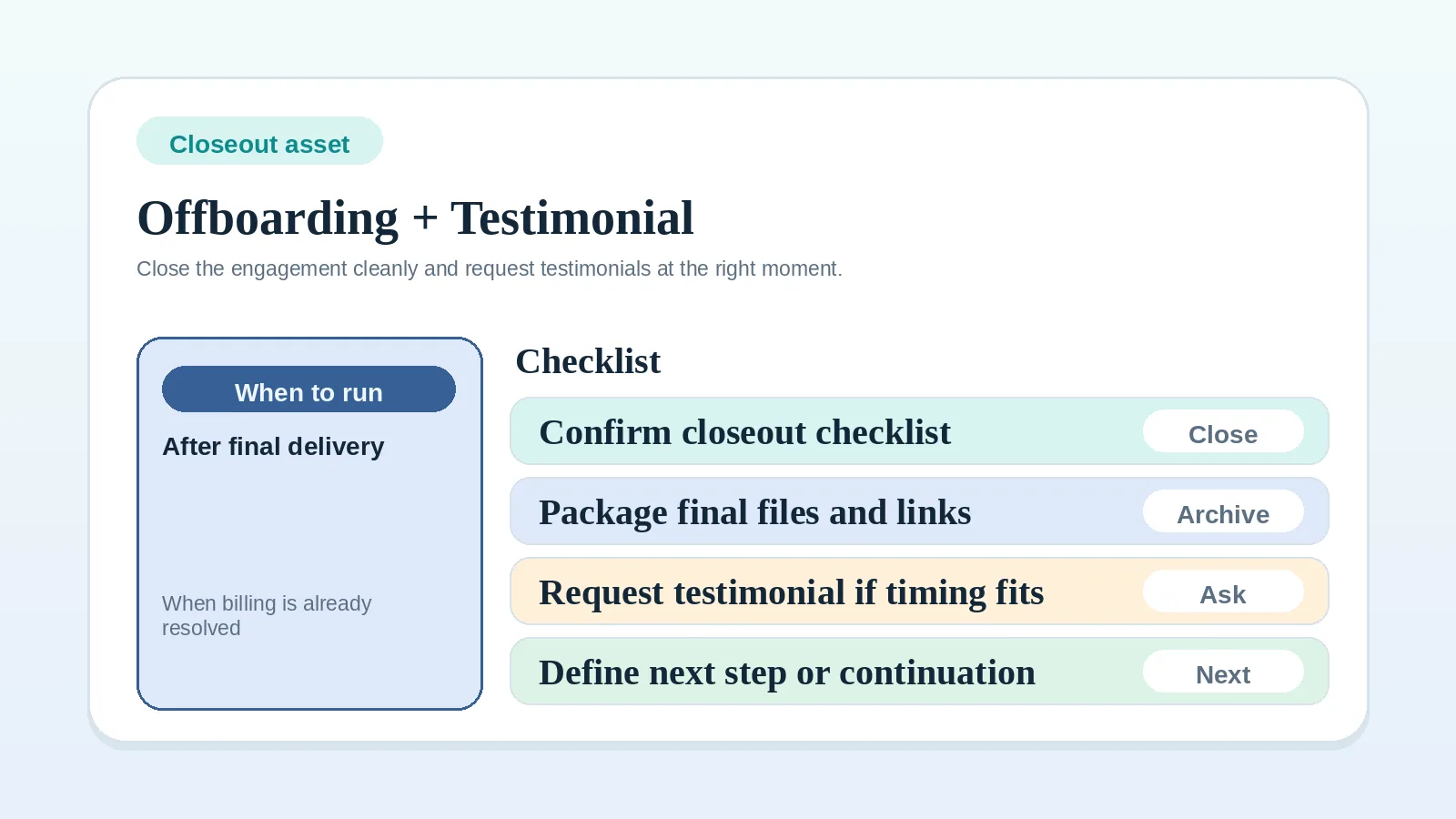
This template records the final handoff, closeout status, archive actions, and any testimonial or referral request you decide is appropriate. Complete it after the delivery, signoff, and billing states are clear under the project’s agreement.
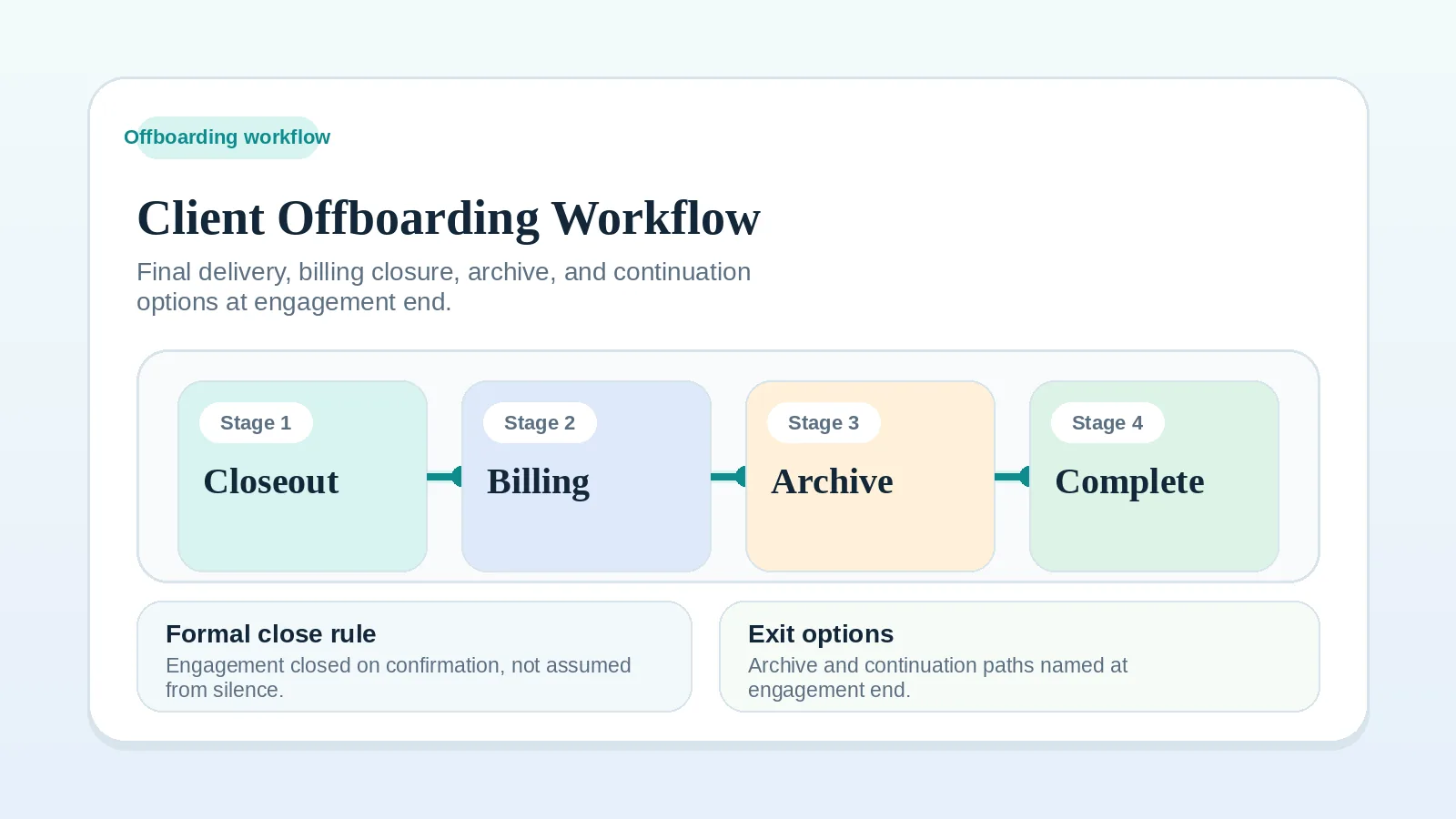
Read Client offboarding workflow for freelancers and solo service businesses first if the sequence or conditions for closing the engagement are still unclear.
Confirm the closeout conditions first
- delivery is recorded as complete under the agreement,
- billing status is already visible,
- the closeout rule is clear,
- you know whether the testimonial ask should happen now or be deferred.
If closeout timing, signoff, or billing state is still unclear, go back to the offboarding or billing workflow first.
What the template covers
- closing a completed engagement,
- recording outcomes the client has confirmed,
- sending a testimonial request at the right moment,
- preserving the next-step opportunity without forcing it.
It does not cover:
- resolving delivery disputes,
- chasing unresolved invoices,
- replacing a broader client-retention strategy,
- fixing a project that never had a clean handoff in the first place.
Treat the testimonial request as optional. Send it only when the project record supports the claims you invite the client to make and no unresolved delivery, billing, or relationship issue makes the request inappropriate.
Offboarding template
1) Delivery closure
- Confirm all contracted deliverables are complete.
- Confirm final asset transfer is done.
- Confirm client has access to all final materials.
2) Outcome summary
- Document what was delivered.
- Document measurable outcomes where available.
- Document open recommendations for the next phase.
3) Billing closure
- Confirm final invoice is issued and tracked.
- Reconcile the payment status and remaining balance. Keep financial follow-up open with an owner if operational closeout is permitted before payment is settled.
- Confirm no unresolved scope-change items.
4) Testimonial request
Use this simple request structure:
“Thanks again for working together. If you found this project valuable, would you be open to a short testimonial on your experience and results? A few sentences on the problem, process, and outcome would be helpful.”
5) Referral and future-work request
- Ask if they know another team with similar needs.
- Offer next-step engagement options only if clearly relevant.
6) Internal process review
- Record one thing that worked well.
- Record one process issue to improve before the next project.
Records to preserve before archiving
Before you archive the engagement, capture:
- the final approval evidence, handoff record, and any remaining billing or support responsibility,
- who retains the required records and how they can be retrieved,
- which access permissions end now and which remain necessary for agreed support,
- feedback the client actually provided,
- what slowed the project down,
- what would need to change if the work repeated,
- whether there is a realistic follow-on need.
These notes give a later project owner a usable account of the closeout.
Confirm that the client can use the transferred materials before removing access needed for the handoff. Remove permissions that are no longer needed, and schedule a review of access retained for support.
Delay or omit the testimonial request when
Wait if:
- final billing is still unresolved,
- the client has not actually received or reviewed the final assets,
- there is visible frustration or an open issue that still needs closure.
Do not infer satisfaction from silence or technical completion. Ask only when a request is appropriate to the actual relationship and the claims can remain accurate.
Closeout gaps to avoid
- Requesting a testimonial before the client has fully received the final assets.
- Closing the project in your head but not in the billing or delivery records.
- Archiving the project without recording the delivery, billing, and signoff state.
- Offering the next project too aggressively before confirming satisfaction with the current one.
Decide these closeout variations explicitly
- If the client was happy with the work but late on approvals, ask for feedback first and testimonial later.
- If there is likely follow-on work, separate the closeout note from the expansion conversation so the testimonial ask does not feel transactional.
- If outcomes are not yet established, do not invite a results claim. A process-focused request is an option only if it accurately reflects what the client can assess.
Closeout record check
Offboarding is complete only when:
- project assets and outcomes are documented,
- payment state is clear,
- testimonial or feedback ask is either sent or intentionally deferred,
- one internal improvement is captured for the next engagement.
Guides and records used at closeout
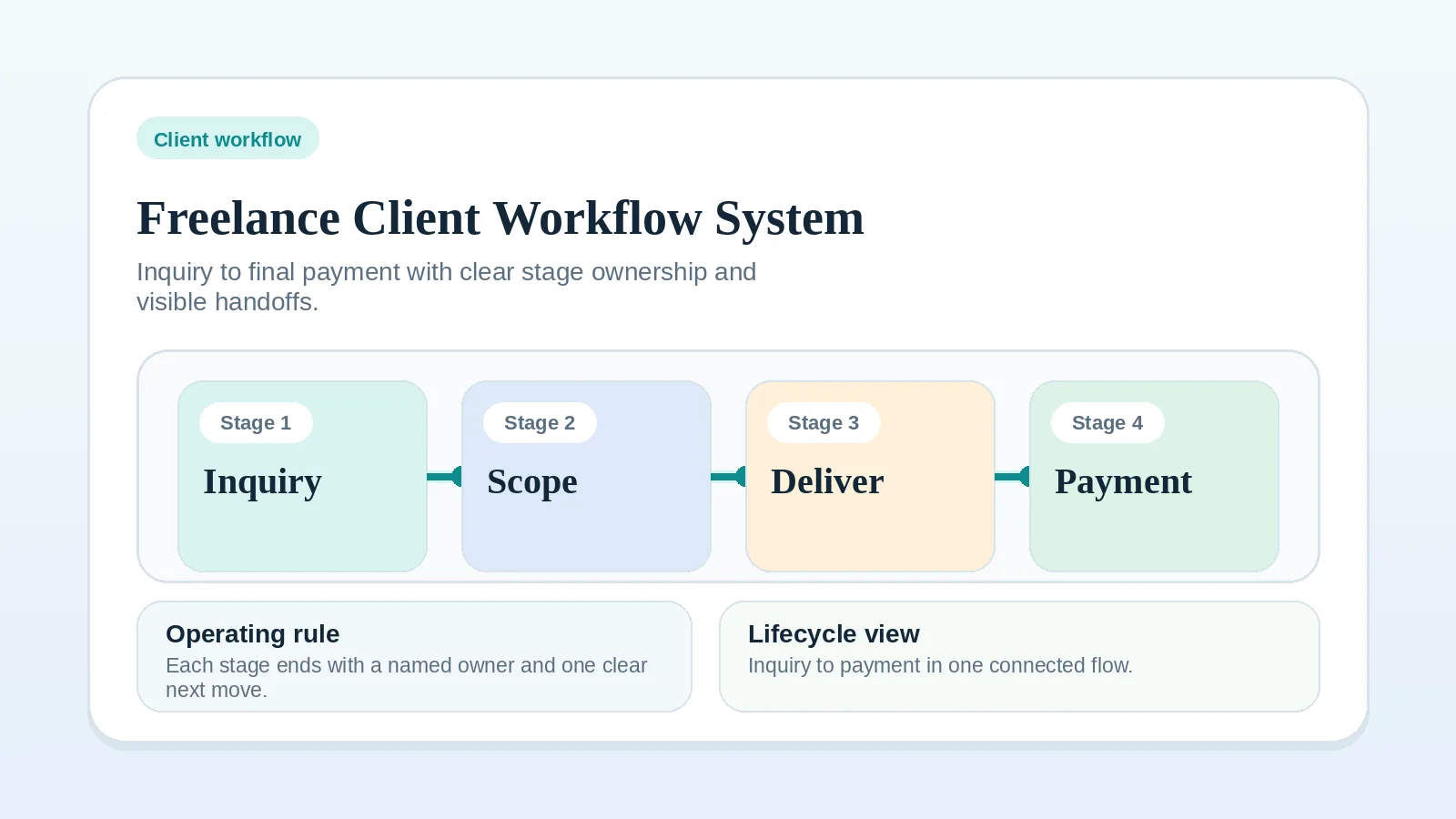
- End-to-end system: Freelance client workflow system: inquiry to final payment
- Offboarding workflow: Client offboarding workflow for freelancers and solo service businesses
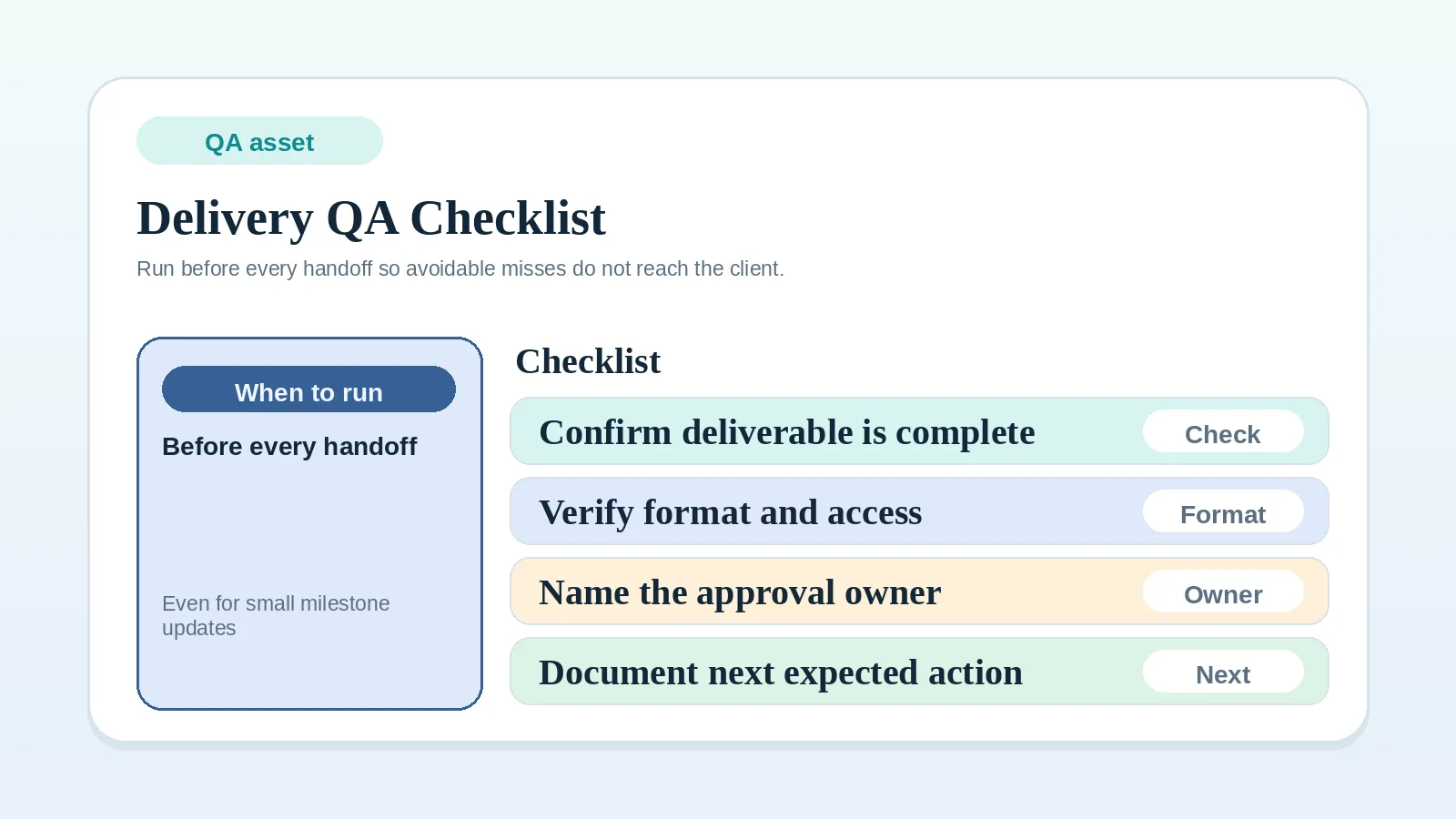
- Final handoff quality: Delivery QA checklist before client handoff
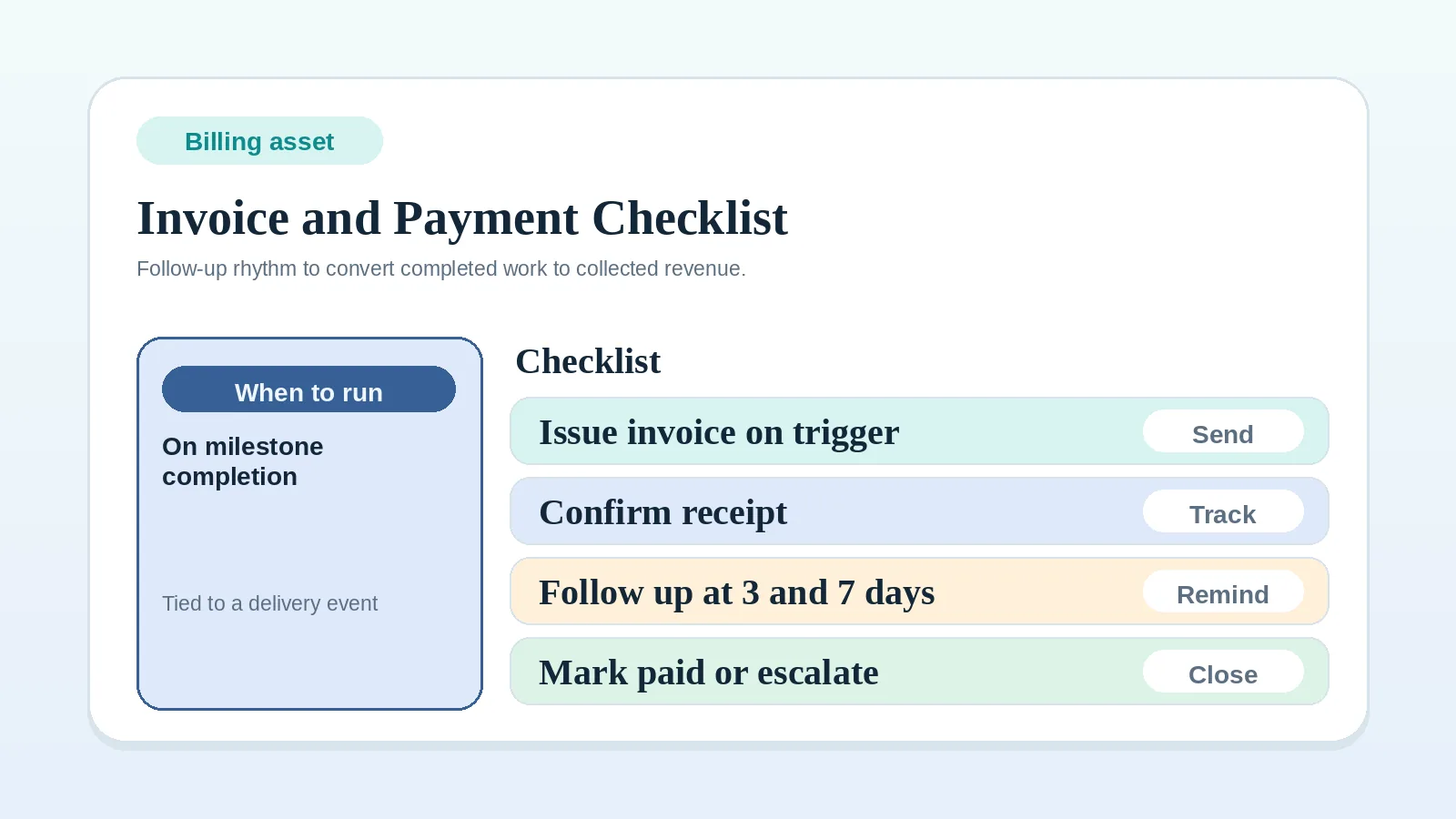
- Payment closeout discipline: Invoice and payment workflow checklist
Archive the project and route recurring gaps
After offboarding:
- archive the project cleanly,
- note one workflow improvement for the next engagement,
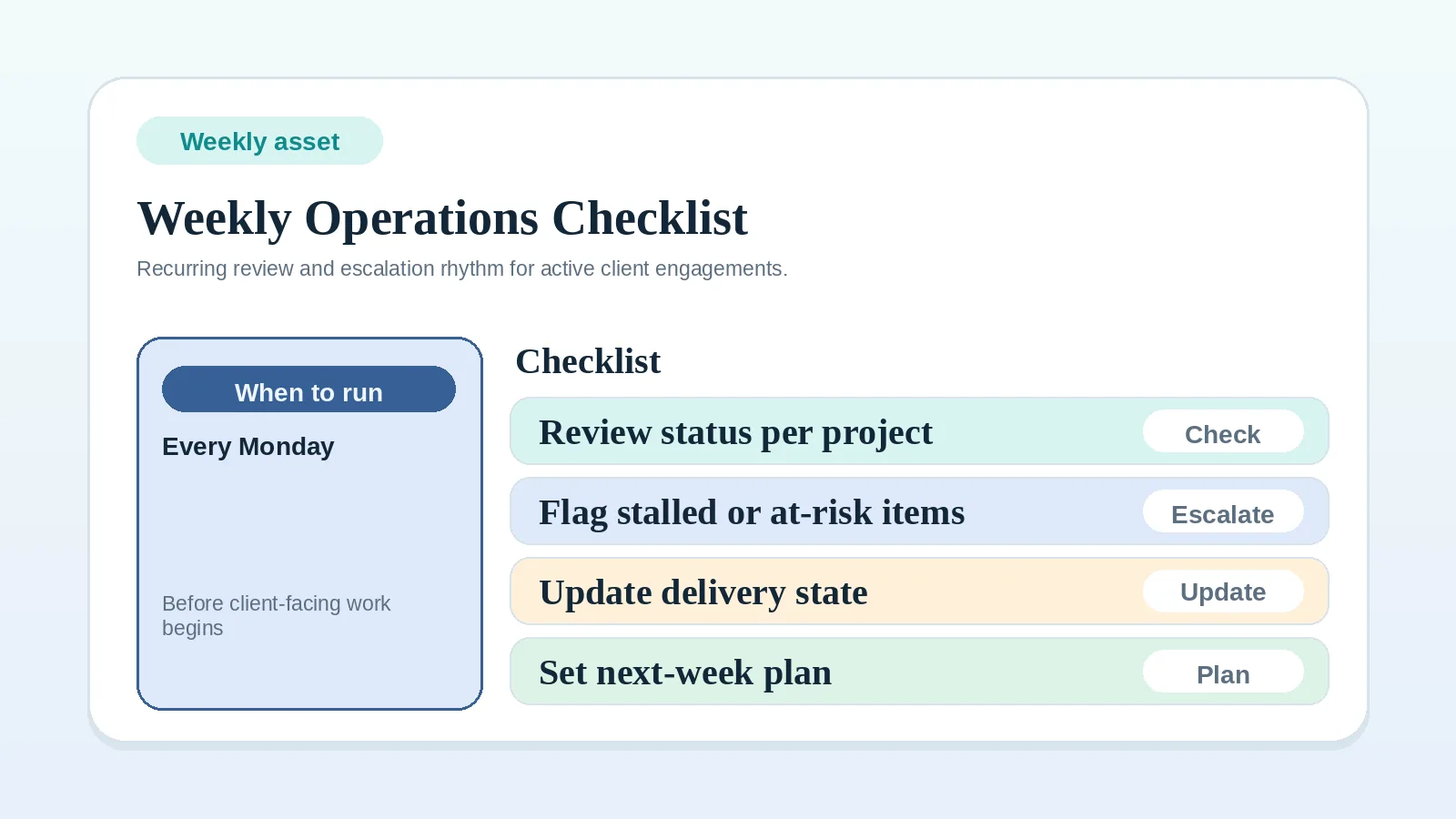
- carry recurring issues into your next Weekly client operations checklist review.
If a pattern keeps breaking during closeout, revisit the rule that governs it:
- Delivery issues: Milestone delivery workflow for solo service businesses
- Billing issues: Invoice and payment workflow setup
- Full lifecycle confusion: Freelance client workflow system: inquiry to final payment