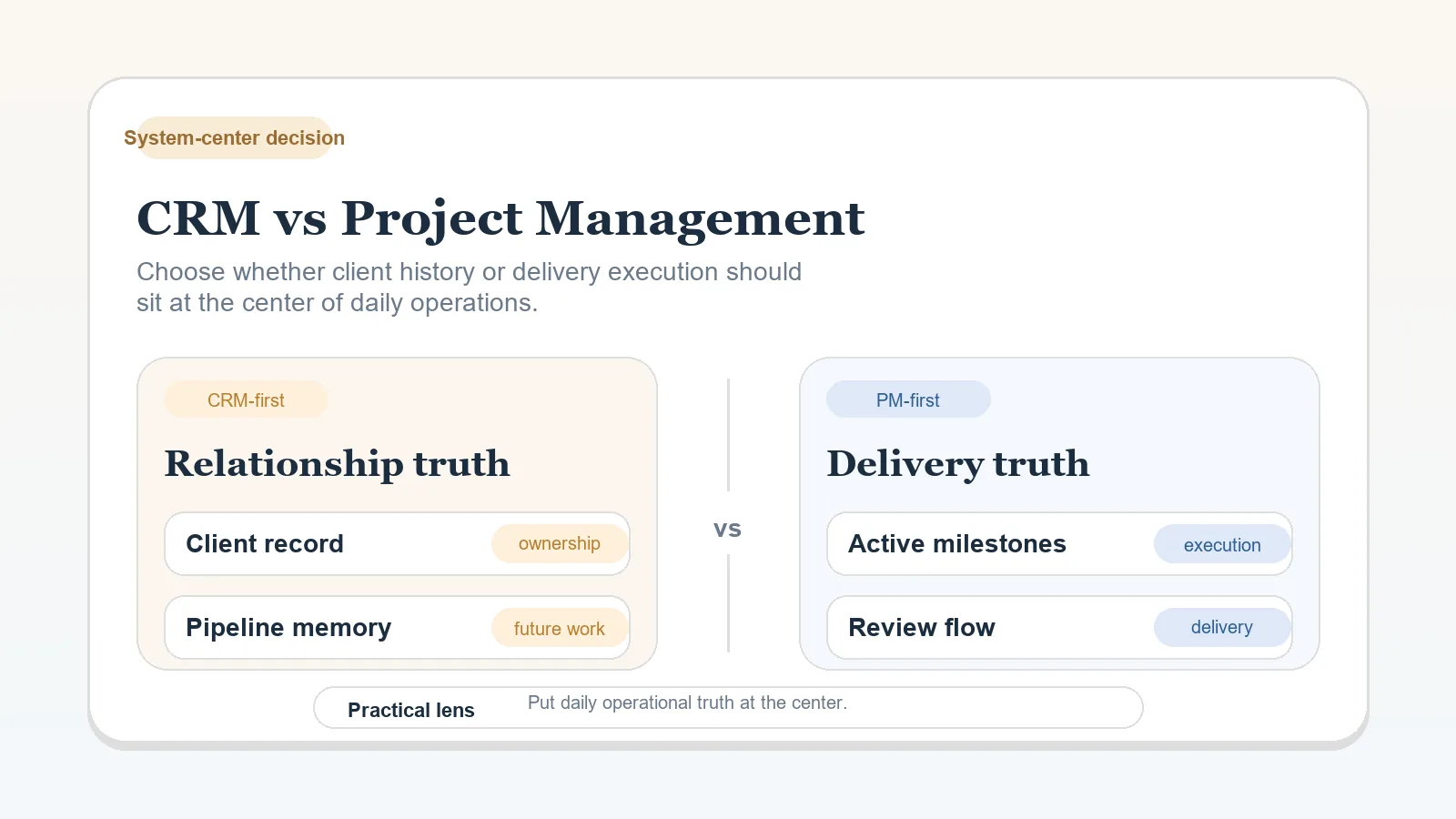
This is not a “which app is best” article. It is an operating-model decision about where active client truth should live — in lead tracking, pipeline, and follow-up (CRM-first) or in delivery tasks, milestones, and project execution (PM-first).

If your process fails because client context gets lost between lead, delivery, and billing, your main issue is usually system-of-record mismatch.

This decision shapes where handoffs, updates, and next actions are maintained across the whole lifecycle. Narrower tool comparisons — workspace, booking, billing visibility — only make sense once this system-center choice is clear.

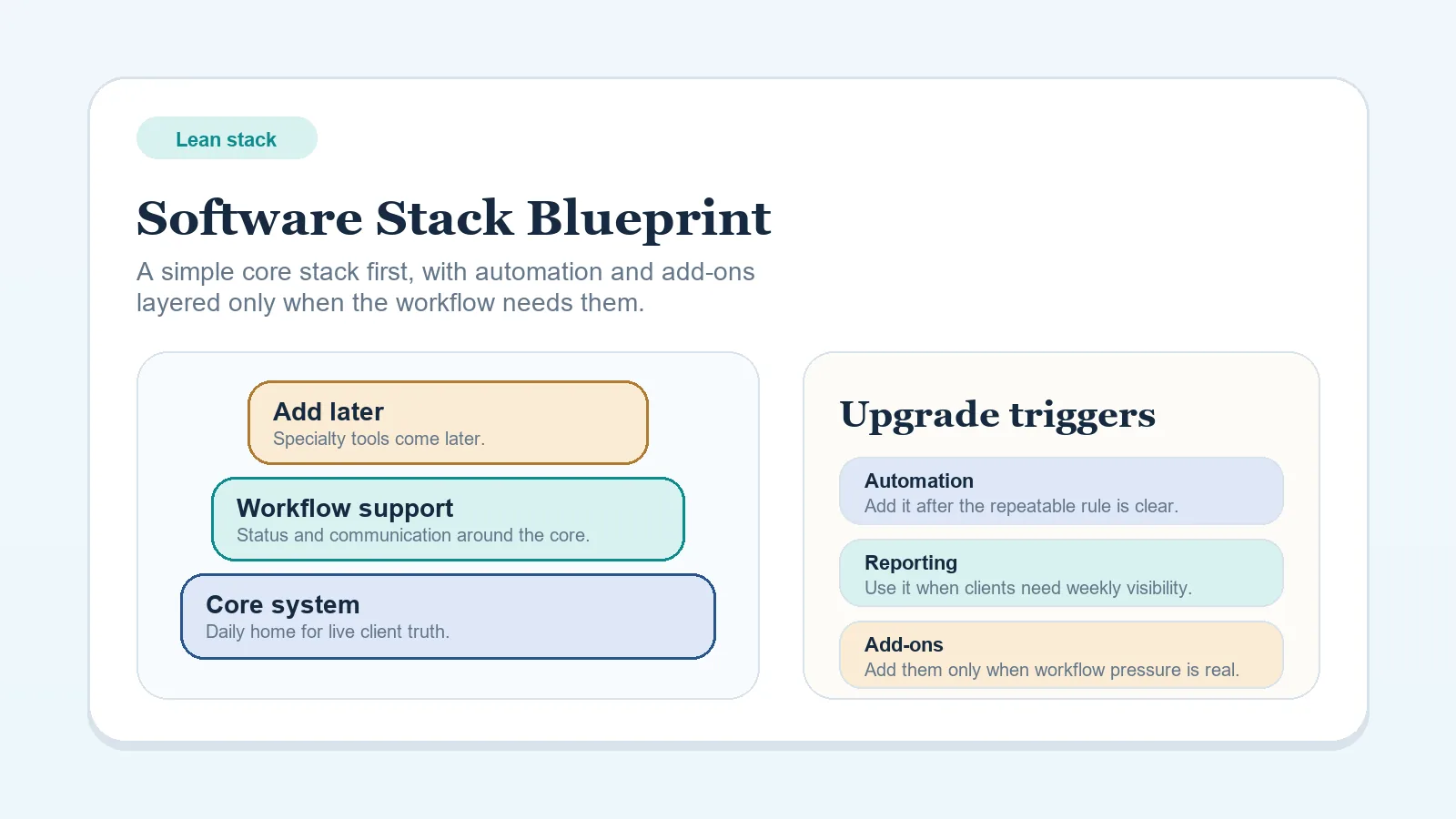
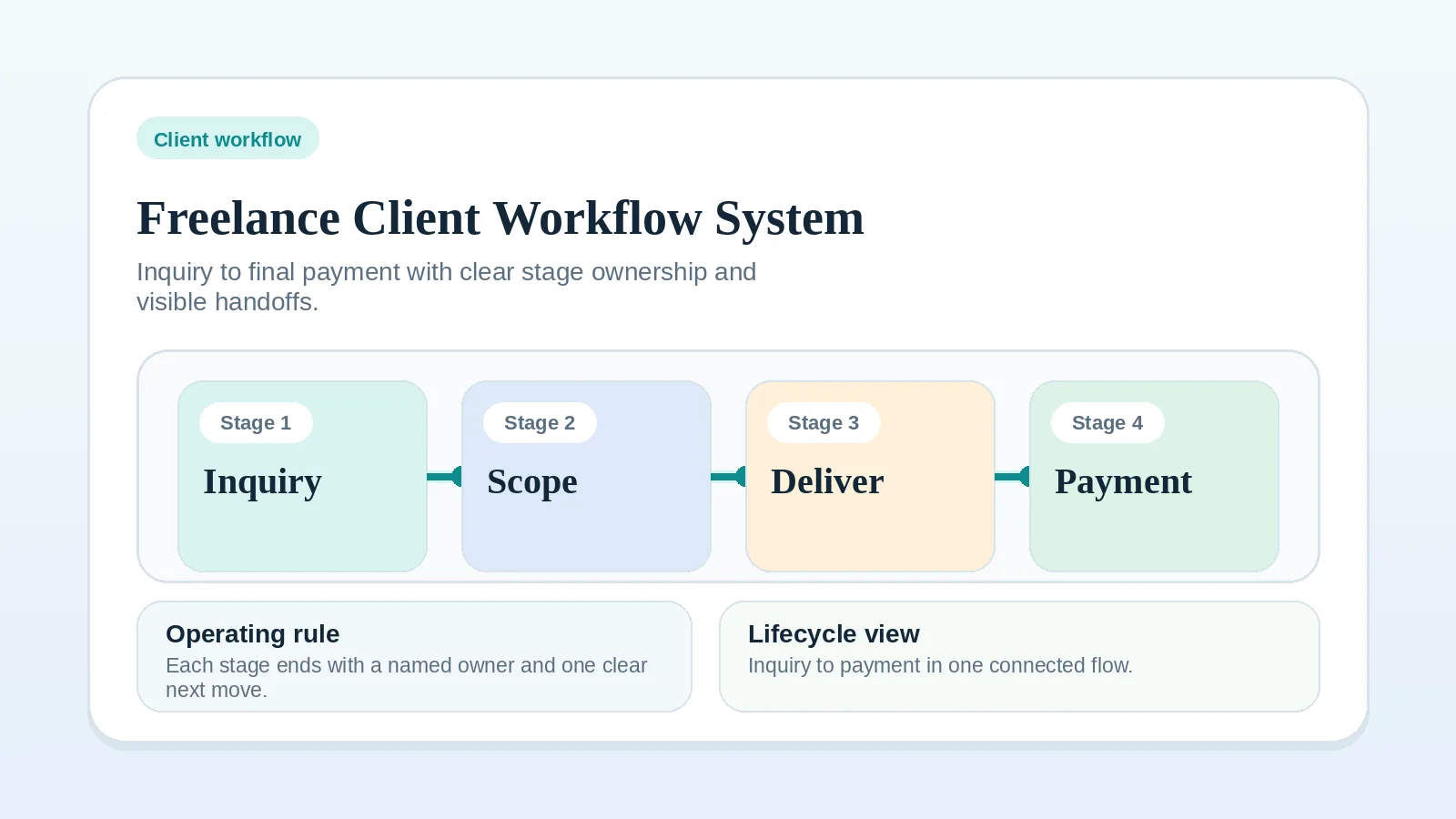
Once that operating-model choice is clear, the next job is usually to implement the stack shape with Software Stack Blueprint: Solo Freelancer (Lean Budget), not to keep browsing tool-level comparisons. If the lifecycle itself is still broad and fuzzy, go back to Freelance Client Workflow System: Inquiry to Final Payment instead of staying inside comparisons.

If you are close to choosing tools but still need to verify that lifecycle stages, ownership rules, approval triggers, and billing visibility are clear enough, use the Stack Decision Readiness Checklist for Solo Operators before committing to a CRM-first, PM-first, or hybrid model.

When this page is the right starting point

This is the right page if the open problem is where active client truth should live. It is the wrong page if the system center is already settled and you only need a workspace comparison, billing-visibility rule, or implementation asset.

What this page should not decide

This page should not decide:

  • which exact CRM or PM app to buy,
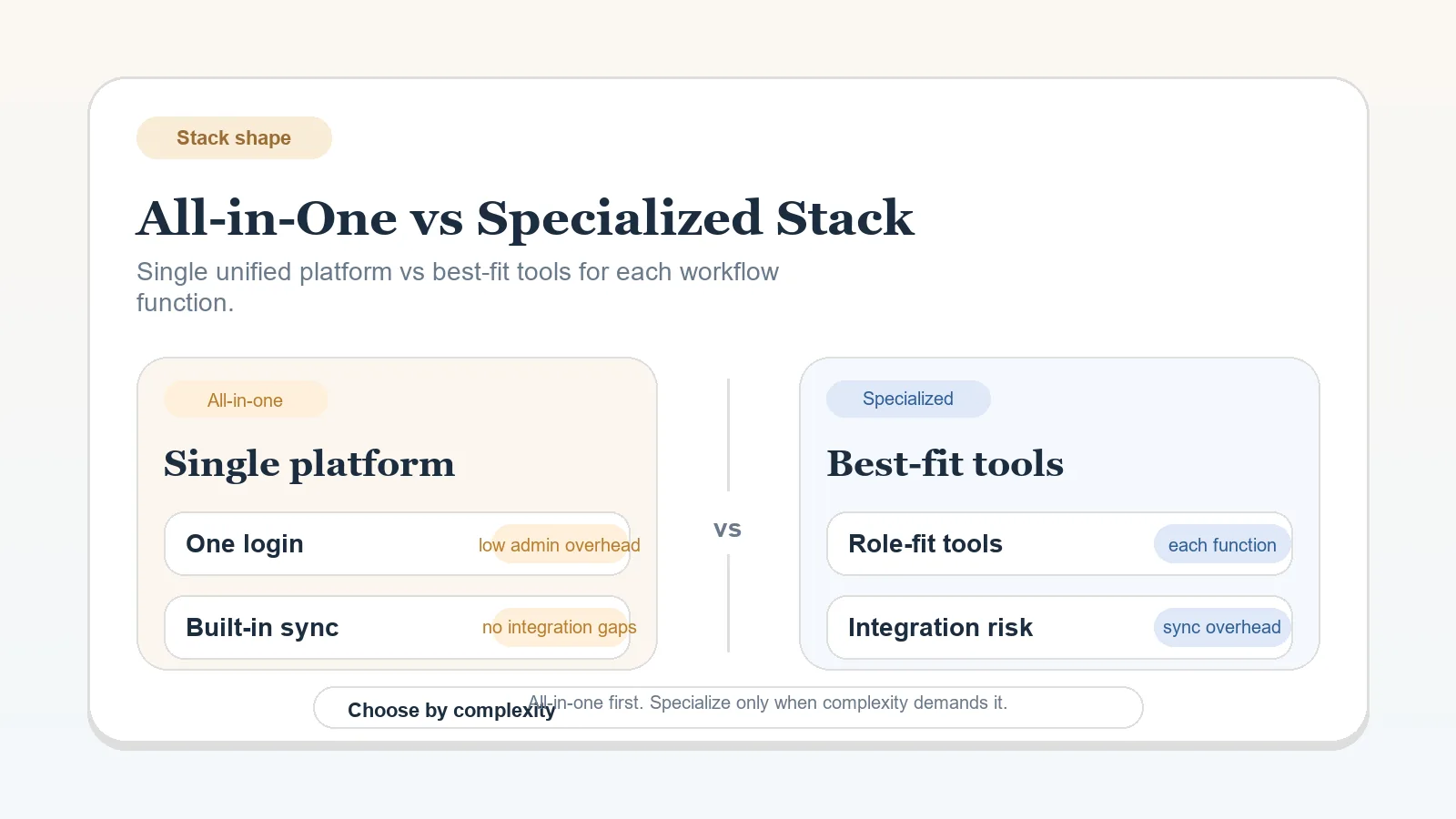
  • how many tools belong in the full stack,
  • whether review, booking, or portal tooling needs separate optimization.

Those are downstream questions. This page only decides where active client truth should sit.

Start somewhere else first if…

  • the whole lifecycle still feels messy and you cannot name where truth should live yet,
  • your main issue is broader stack shape rather than system center,
  • you are already committed to one center and only need to choose a delivery workspace.

In those cases, start with Freelance Client Workflow System: Inquiry to Final Payment if the lifecycle is still unclear, or Software Stack Blueprint: Solo Freelancer (Lean Budget) if the system center is already settled and stack shape is the remaining question.

Who this page is really for

Use this page when:

  • both sales and delivery feel messy and you are not sure which side should anchor the system,
  • you keep duplicating client status across tools,
  • you are considering a new workspace but the deeper issue may still be system shape.

Do not use this page when the system center is already clear and you are only choosing a delivery workspace. In that case, move down to Notion vs ClickUp for Solo Client Delivery.

Why this page matters first

Start here before workspace or tool-level comparisons if:

  • you still do not know where active client truth should live,
  • both sales and delivery feel messy and you are considering adding more software,
  • downstream tool comparisons feel premature because the system center is still unclear,
  • support pages are naming symptoms but not resolving the operating-model decision.

Decision context: what you are actually choosing

You are choosing where the truth about client work lives:

  • CRM-first model (client lifecycle and follow-up as the center)
  • PM-first model (delivery execution as the center)
  • Hybrid model (both, with explicit boundaries)

For end-to-end process context, use the anchor page first: Freelance Client Workflow System: Inquiry to Final Payment.

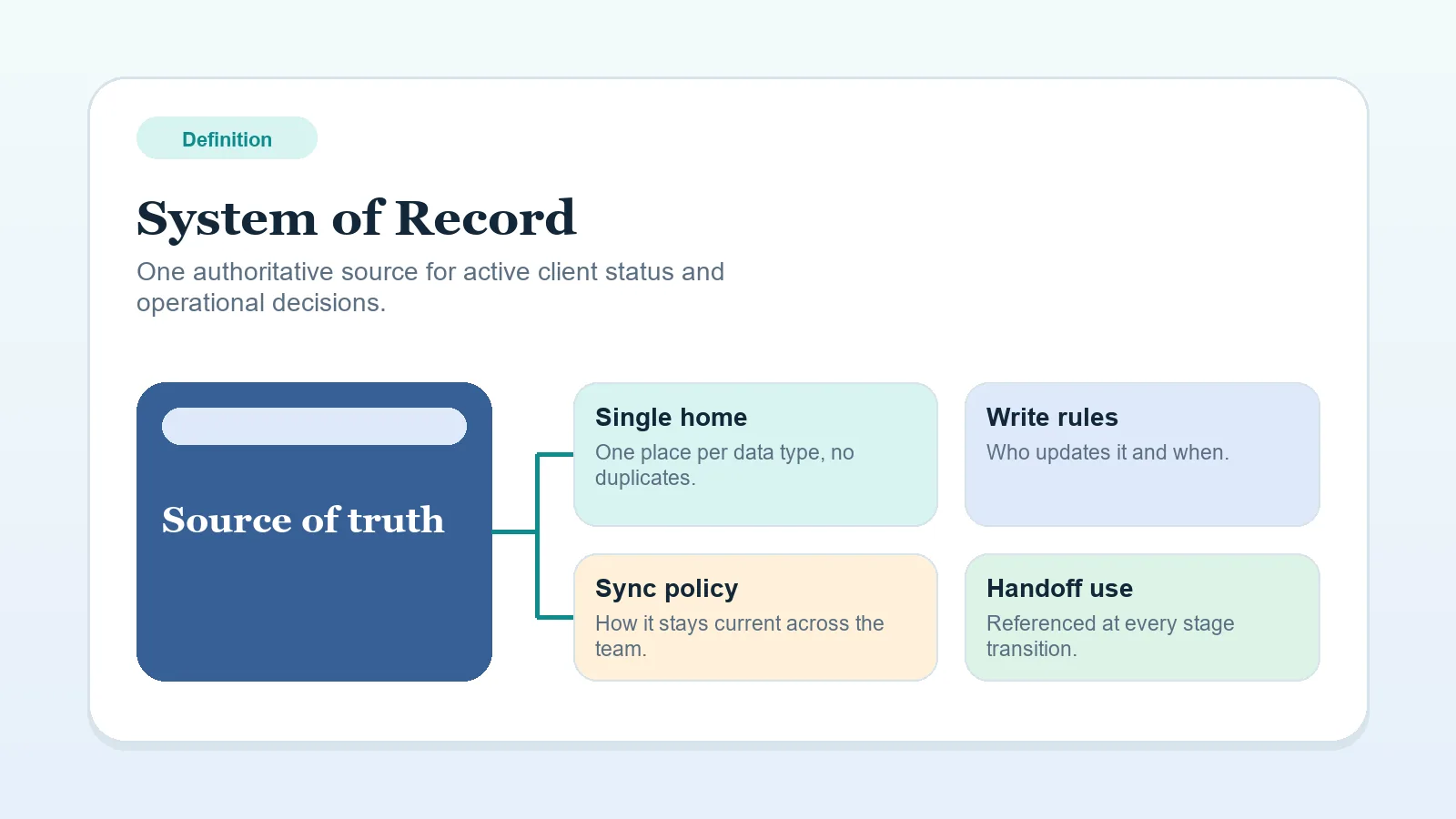
If you need the definition behind this choice, read System of Record first.

What this comparison should settle

By the time you leave this page, you should be able to answer:

  • whether CRM, PM, or hybrid should hold active client truth,
  • what the main failure mode of the wrong choice would be,
  • whether a narrower comparison is actually needed next,
  • which page should turn the decision into implementation.

Why this decision changes the rest of the stack

Once the system center is chosen, other decisions become narrower:

  • blueprint pages can define the stack around that center,
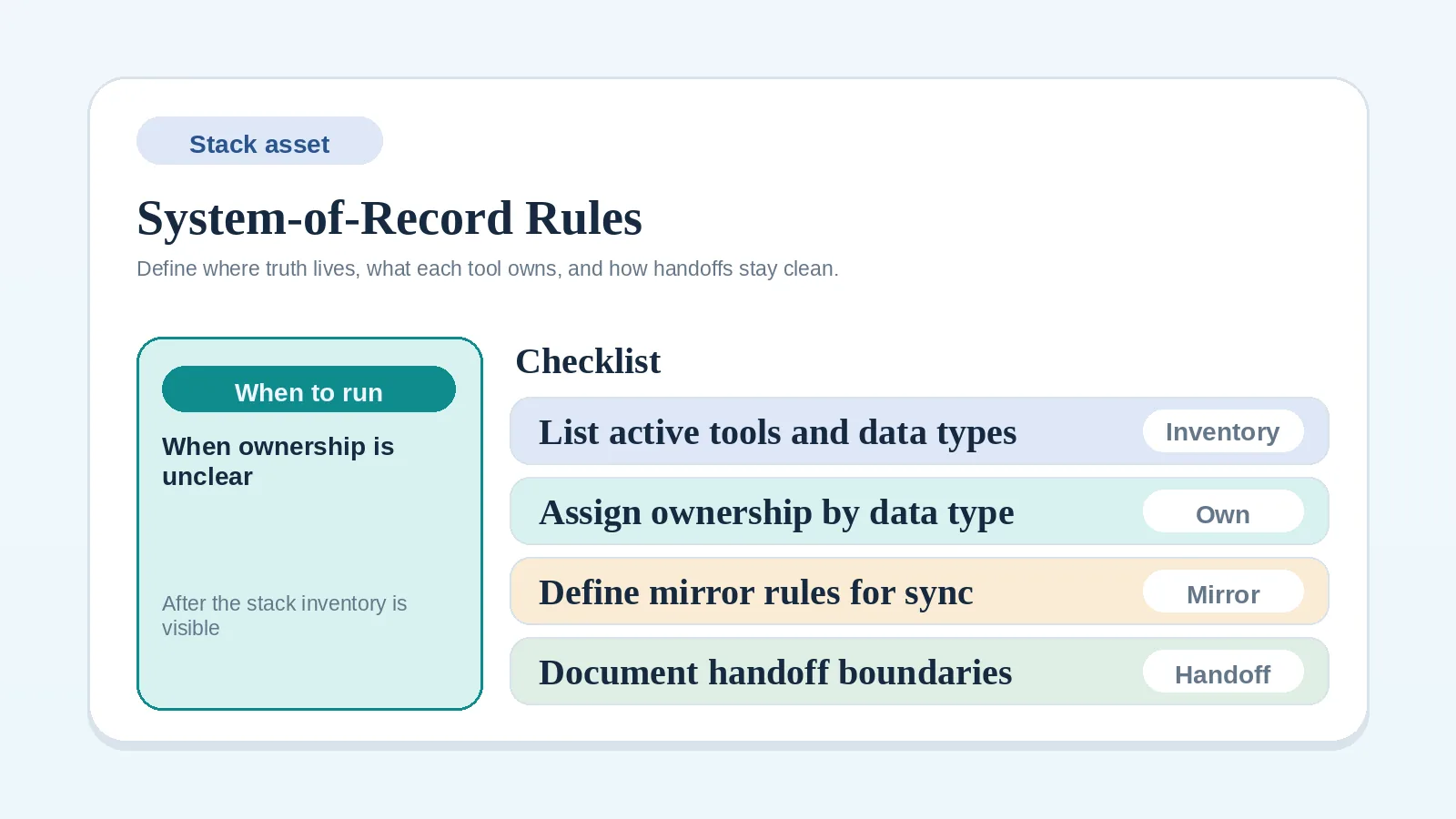
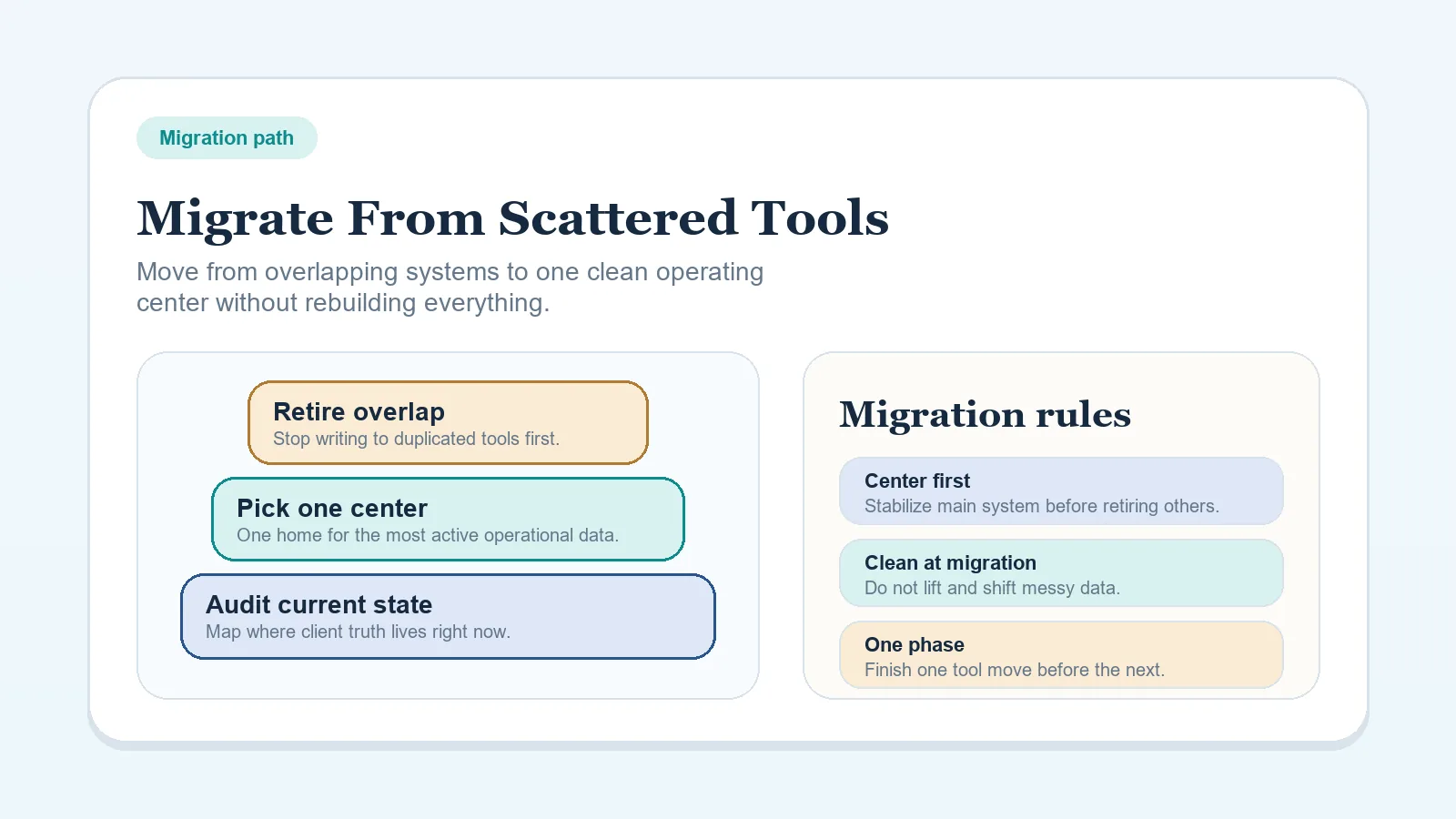
  • support worksheets can document ownership and migration boundaries,
  • narrower comparisons stop competing with each other.

If this decision stays fuzzy, the rest of the stack usually grows sideways.

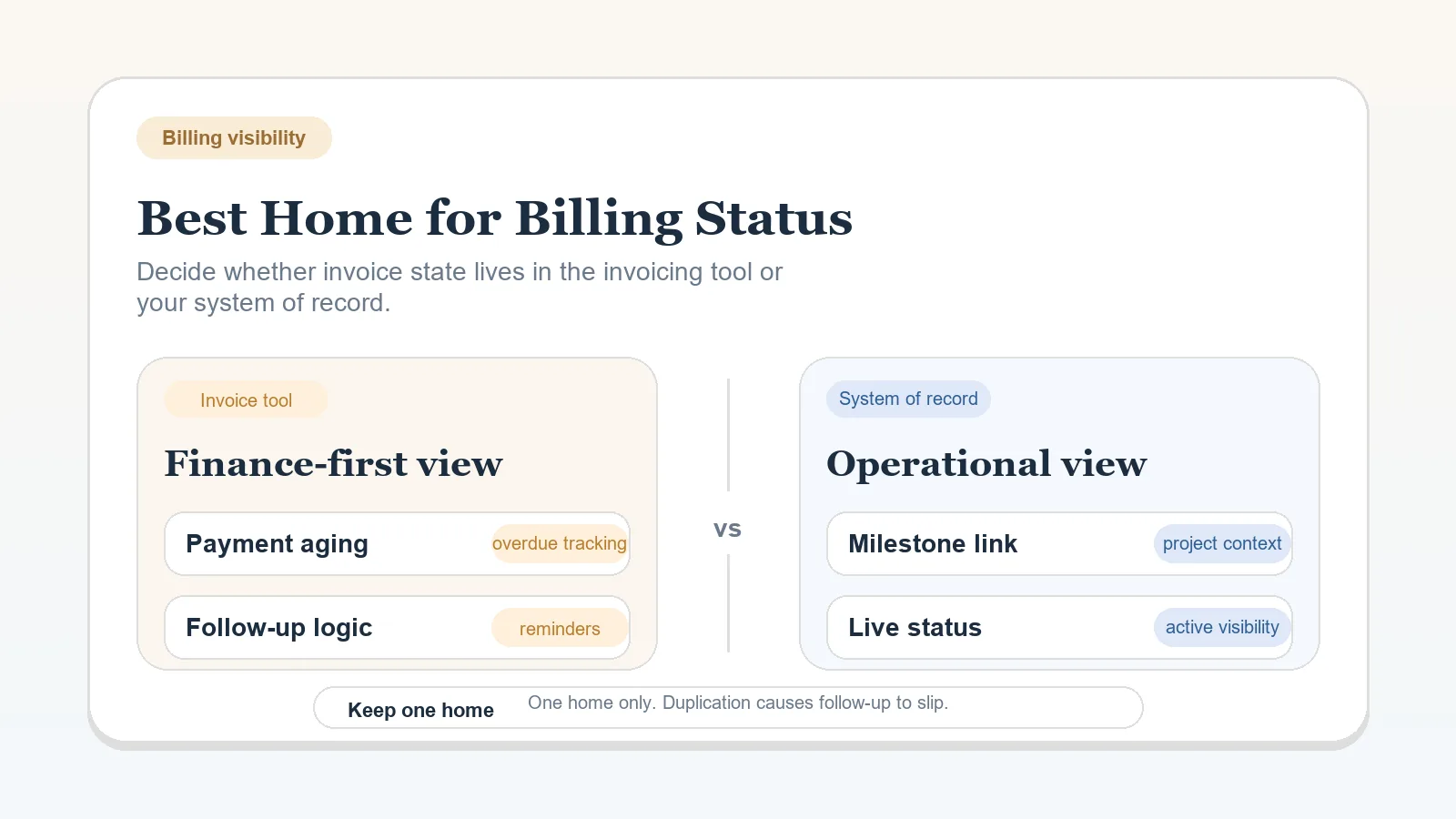
One downstream consequence people miss is billing visibility. Once the system center is chosen, you still need to decide whether invoice status lives only inside the invoicing tool or remains visible in the main operating record too. That narrower boundary belongs on Best Home for Billing Status: Invoicing Tool vs System of Record.

Model 1: CRM-first

Best for:

  • high lead volume,
  • multiple opportunities per month,
  • long sales cycle before delivery starts.

Strengths: better pipeline visibility, clearer follow-up ownership.

Tradeoffs: delivery tracking may be weak unless process is documented elsewhere.

Failure mode: clients are won but delivery execution becomes scattered.

Good fit scenario: you manage a steady lead pipeline, proposals sit open for a while, and missed follow-up costs more revenue than delivery slippage.

Model 2: PM-first

Best for:

  • low-to-medium lead volume,
  • delivery-heavy business,
  • repeatable scoped services.

Strengths: milestones, dependencies, and deliverables are easier to track.

Tradeoffs: pre-sale and opportunity tracking can be limited.

Failure mode: weak lead qualification and inconsistent follow-up before kickoff.

Good fit scenario: your business is delivery-heavy, lead volume is manageable, and most operational pain shows up after the project starts.

Model 3: Hybrid

Best for:

  • operators running both active pipeline and multi-project delivery,
  • businesses where sales and delivery are equally complex.

Strengths: strongest visibility across full lifecycle.

Tradeoffs: higher admin overhead and integration complexity.

Failure mode: duplicated data, inconsistent ownership, and process confusion.

Good fit scenario: you can clearly explain what changes the moment a deal closes and who maintains each system after that point.

Criteria matrix

CriteriaCRM-firstPM-firstHybrid
Pipeline clarityStrongLimitedStrong
Delivery executionMediumStrongStrong
Admin overheadMediumLowHigh
Setup complexityMediumLowHigh
Best early-stage fitIf lead-heavyIf delivery-heavyRarely

A practical shortcut for choosing

  • Choose CRM-first if you lose more revenue before kickoff than after kickoff.
  • Choose PM-first if most friction appears after the work starts.
  • Choose Hybrid only if both problems are persistently true and you can name the ownership boundary between the two systems.

If the boundary sounds vague, hybrid is probably premature.

Useful default:

  • PM-first if delivery pressure is your weekly operating reality,
  • CRM-first if pipeline follow-up is the clearest source of lost revenue,
  • hybrid only when you can describe the signed-deal handoff in one clean rule.

Decision criteria that matter more than software features

Lead-to-delivery ratio

If your pre-sale motion is long, active, and valuable, CRM-first usually earns its keep. If most of the work is already sold and the challenge is delivery consistency, PM-first usually wins.

Frequency of status checks

Ask where you look most often during a live week:

  • pipeline follow-up and opportunity movement,
  • milestone status and delivery blockers,
  • both at meaningful volume.

That answer is usually a strong clue about the record that should sit closest to your daily work.

Handoff tolerance

If you hate duplicated admin and can operate well with one center of gravity, avoid hybrid until constraints force it. Hybrid is only worth the extra coordination when both halves of the business are genuinely active and complex.

Choose this if

  • Choose CRM-first if you lose deals due to weak follow-up and have a meaningful sales pipeline.
  • Choose PM-first if work delivery quality is your bottleneck and lead flow is manageable.
  • Choose Hybrid only if you can define strict ownership rules and maintain both systems consistently.

Practical scenarios

Scenario A: solo consultant with 3-8 active clients

PM-first is usually the cleaner default. Intake can be simple, and the bigger risk is missed delivery coordination once work begins.

Scenario B: consultant with long sales cycles and multiple pending opportunities

CRM-first often makes more sense because weak follow-up costs more than delivery complexity.

Scenario C: consultant plus VA with active sales and active delivery

Hybrid can work, but only with a written rule such as:

  • CRM owns pre-sale pipeline through signed agreement.
  • PM workspace owns onboarding, delivery, billing triggers, and active project state.

Next-step implementation by model

If the question is still broader than tool category choice, return to Freelance Client Workflow System: Inquiry to Final Payment before opening narrower workspace comparisons.

Edge cases that change the answer

  • If billing and compliance needs are unusually strict, a CRM-first or hybrid setup may become more valuable earlier.
  • If you sell very few projects but each one is delivery-heavy, PM-first may still beat CRM-first even with a formal pipeline.
  • If you are already using both systems but cannot explain which one is authoritative after contract signature, stop expanding the stack and define the boundary first.

Common missteps to avoid

  1. Buying both CRM and PM tools before process is documented.
  2. Letting sales notes live in chat while delivery lives elsewhere.
  3. Choosing hybrid because it sounds advanced, not because constraints require it.

Quick decision snapshot

  • Choose CRM-first when lead flow and follow-up reliability are your top bottlenecks.
  • Choose PM-first when delivery execution quality and milestone visibility are your top bottlenecks.
  • Choose Hybrid only when both lead and delivery complexity are consistently high and you can maintain clear ownership boundaries.

If still unsure, start PM-first for simpler operations and add CRM depth only when pipeline complexity demands it.

Best next page by outcome

Quick failure check

You probably chose the wrong model if:

  • two systems both claim to own current client stage,
  • delivery still runs from chat or inbox despite the chosen center,
  • signed deals cross into active work without a visible handoff rule,
  • the hybrid model added maintenance but not clarity.